

The Book I Didn’t Write
Sweepings from the cutting room floor, two decades after "And a Bottle of Rum"

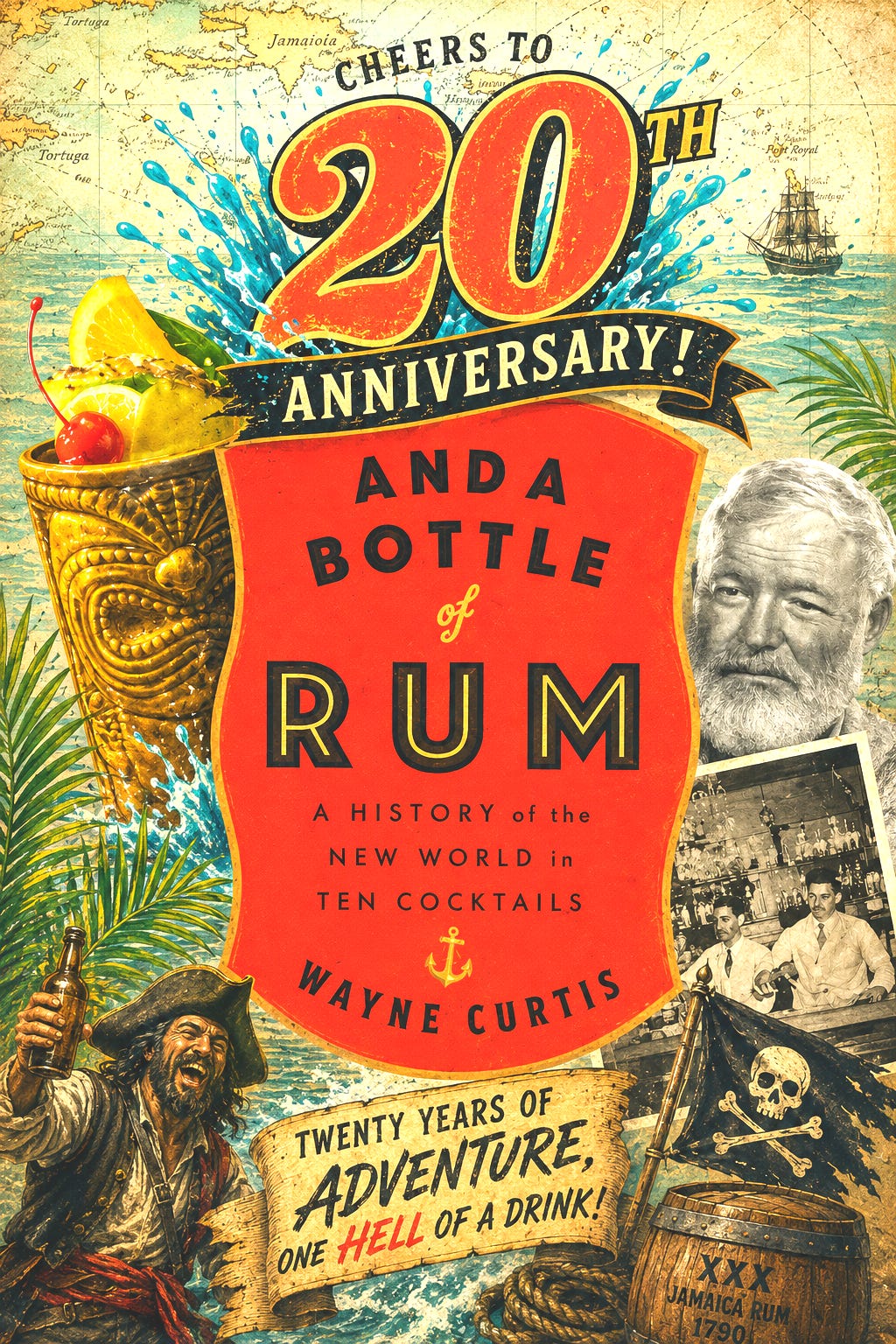
Last month marked the 20th anniversary of And a Bottle of Rum, A History of the New World in 10 Cocktails. This was the book that set me off on an unexpected career researching and writing about liquor, cocktails, bars and their culture and history. I initially wrote the book not because I had an interest in spirits and cocktails, but because I was a history dork, and was curious about why rum kept cropping in so many American chronicles, from the slave trade and piracy, to the American Revolution and Prohibition.
The book was published in July 2006. It sold well. And it still sells well, which pleases me and surprises my publisher. Thanks to all those who rejected the downbeat trends regarding reading books and drinking liquor. Keep being you!
In the course of writing the this I compiled a 137,000-word document with all sorts of stray information and quotes I had culled over two years of research — traveling to islands, burrowing in libraries, talking to experts. When I sat down to write, I printed out all 240 pages on actual paper, then cut each page up with actual scissors and filed each fact into the appropriate chapter folder. (It was before Evernote.) Then I pulled down the first folder, started writing, and when that chapter was completed, I pulled down the second. Repeat. Eventually a book happened.
Last week I opened that Word research document and scrolled through for the first time in a long while. It was entertaining, like leafing through an album of long-forgotten photos. I remember that 1829 book, Wine and Spirit Adulteration Unmasked! But what struck me was how little of the research made it into the book — if 30 percent found its way to print, I’d be surprised. All the information that got left on the cutting room floor could practically make for a whole other book.
Which I assure you it won’t. But I did gather up some of those cuttings. These outtakes told a sort of secondary oral history of rum and spirits in America, and could serve a launchpad for further research.
None of it proved useful enough for the book. All of it was too good to delete. Here’s what got left behind.
“The quantity of ardent spirits consumed in this country surpasses belief.”
— Circular Address to the Members of the Massachusetts Society, 1814
“Madness and idiotism by no means infrequently follow the excessive use of ardent spirits.” — Alexander Read, 1817
“From 1802 to 1815 the federal government issued more than 100 patents for distilling devices; these patents were more than 5 percent of all patents granted....” — W.J. Rorabaugh, 1979
The pirate Edward Low “offered the captain of a Vrginia prize a bowl of punch and when the trembling prisoner declined saying he was much too shaken up, Low put his pistol to the poor man’s head with one hand, held the tankard in the other, and told him to choose one or the other. Overcoming his nerves, the captain downed about a quart.” — Jennifer Marx, 1992
“Idleness is sorrow and breeds Drunkards as naturally as stagnant water breeds bull-frogs.... Idleness leads to gambling, gambling to losses, losses to sorrow, and sorrow to drunkenness and ruin.” — M.L. Weems, 1838
During the Civil War: “With the scarcity of breadstuffs came the enactment of laws which forbade the manufacture of spirituous liquors from edible grains, under heavy penalties of fines and imprisonment, in addition to the confiscation of such liquors and the implements used in their distillation. Large quantities of brandy were made from apples, peaches, and blackberries, and rum made from the juice of the sorghum cane, constituted almost the sole intoxicating beverages of the Confederacy.” — Neal Wilson, 1889
“The frequenters of dram shops... are generally attracted far more by the light, warm, and good fellowship than by the rum.” — Dio Lewis, ca. 1870–80
“Smuggling methods during Prohibition included “immersion tubes”: cigar-shaped metal containers hauled beneath the keel and lashed in place with chains. These could be released at night to be towed in by a smaller boat, or cut away and sunk if the Coast Guard boarded.” — Florida Historical Society Quarterly
“The supreme art of the mixing process was to place the thumb lightly on top of the long spoon and then revolve the spoon at incredible speed by twiddling the fingers. This was a knack acquired by the maestros only.” — George Ade, 1931
“So many inventors are coming forward with processes for the rapid aging of whiskey, brandy, and rum that a large distilling company is said to have set aside an entire floor of its office building for interviewing applicants who expect the use of their methods to revolutionize the industry.... The idea of rapid aging is by no means new, however, for a 12-hour process for aging whiskey was described in a government report of over 40 years ago.” — Scientific American, 1934
“It is possible for the collector of wine and food books to do a bit of international browsing at our World’s Fair. In the Cuban pavilion, for instance, he can get gratis an educational leaflet instructing him in the art of concocting three kinds of Daiquiri cocktails and twelve other thirst quenchers made of Havana rum, including the Mojito and the famous Planter’s Punch.” — New York Times, 1939
“It is to my sorrow that I do not find more Americans adopting [Jamaican rum], for truly beautiful concoctions can be made with the heavy, pungent, and aromatic liquor.” — Vic “Trader Vic” Bergeron, 1946
“Not enough Americans are in the habit of drinking rum straight. Rum and coke is a popular mixture but it’s favored by the less-serious-minded imbibers.” — Wall Street Journal, 1952
“He came out in the afternoon and gave us all kinds of drinks. By the time we were done drinking I could barely find the door.” — Publio Enriquez, a gardener at Ernest Hemingway’s Cuban estate, recalling the day in 1954 when the author won the Nobel Prize for Literature
“Additions commonly made to Demerara rums are various and interesting. They account for the unusually fruity taste and odour, and include plums, raisins, and spices. At one time raw meat was put in the casks both to absorb certain impurities and to impart ‘a certain distinctive character.’” — L.W. Marrison, 1957
“It would be difficult to categorize Trader Vic’s cuisine under a single heading. It is a combination of Cantonese, Indonesian, and islander cooking.... One is inclined to ask why Hungarian goulash figured on a recent luncheon menu.” — Craig Claiborne, 1958
“No other liquor has the protean properties of rum. It suits all seasons and all climates, from the grim arctic winter to the tropical summer of the West Indies, where so much of it is made. It makes fine iced drinks and fine hot drinks, it blends happily with fruits that grow in the regions of its origins, especially the lime, the pineapple, the lemon, and, for cooking, the banana; and it is to tea what brandy is to coffee – only, as we think, more so.” — Julian Street, 1959
“I can’t taste rum without visualizing Yankee clipper ships in full sail, palm fringed Caribbean inlets inhabited by buccaneers, and dimly lit waterfront taverns of the 18th century where our forebears studied maps of buried treasure or planned how to run the British blockade.... A light or medium rum is never oppressive on a hot day.” — James Beard, 1959
“Okolehao, distilled from the root of the ti plant, was originally made by early 19th century whalers, and the name, which translates as ‘iron rump,’ comes from the appearance of the first crude stills cobbled together from blubber boilers by the whalers.... Hawaiian hotels and bars are plugging okolehao mixed with Coca-Cola under the name ‘Coke ’n’ Oke.’ Coca-Cola Bottling Co. of Honolulu is participating in the promotion.” — Business Week, 1962
“To a startling degree, prole America is about sweet. According to a Roper poll, 40 percent of Americans (most of them proles, of course) consume at least one cola or similar drink every day.... Sweet alcoholic drinks are favored by the young and callow of all classes, a taste doubtless representing a transitional stage in the passage from the soda fountain to maturity.” — Paul Fussell, 1983
“Don’t get hung up on the kind of still. There are a lot of variations. Skilled distillers operating single column stills can produce spirits that even trained experts swear came from a pot still. If you think pot stills are the only way to make good spirits, think again.” — Ed Hamilton, 2005
Congrats on twenty years. Pretty sure this book and Kingsley Amis were my first drinks focused book purchases. That Haigh guy and Wondrich soon followed. With them, and Berry you form the heart of my drinks history library. Cheers. Thank you.
Why does rum have such a distinctive fragrance?