

The Case for Working From Bars
Why remote workers, empty barstools, and daytime quiet might finally be a perfect match.

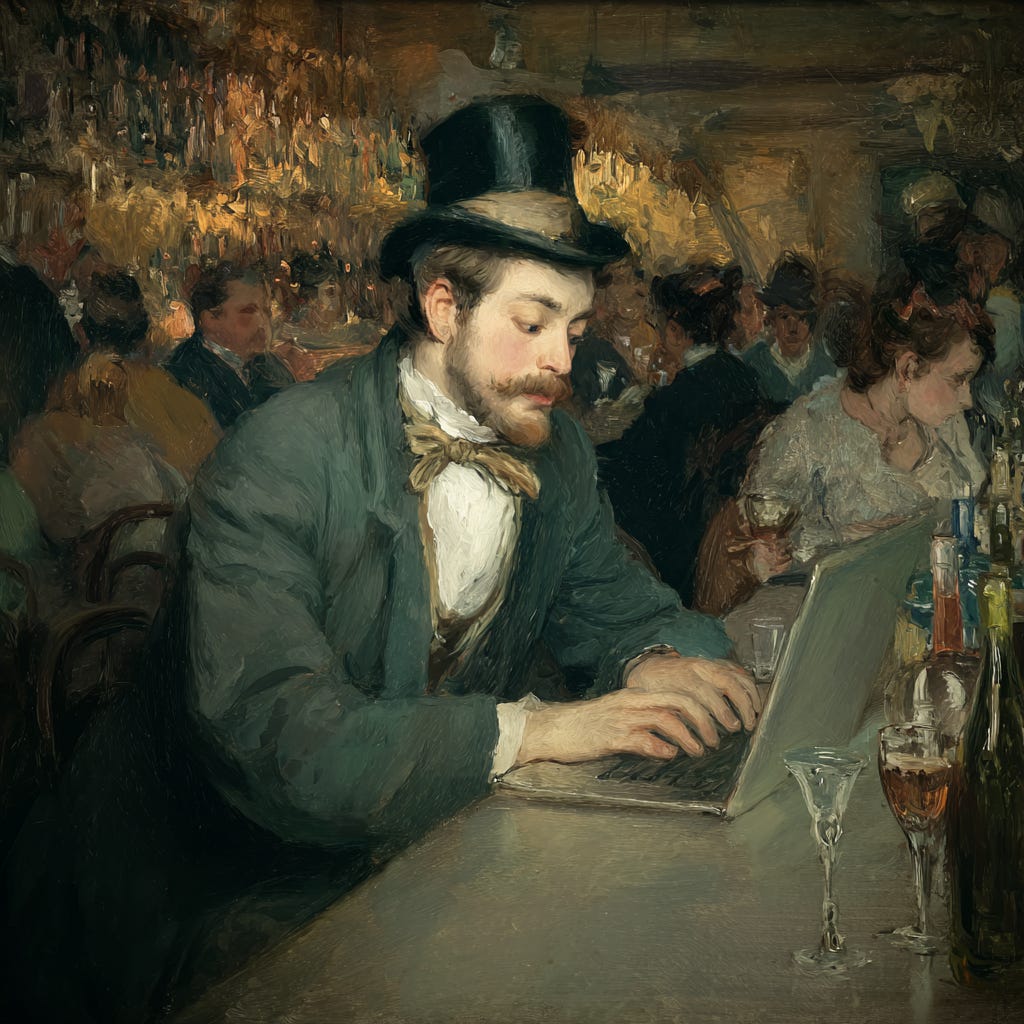
The West Alabama Ice House opened in 1928 and is a ten-minute bike ride from my home in Houston. I love its gritty sincerity, and each time I walk in alone two thoughts come to mind. First, this would be an amazing spot to haul out my laptop and work for a couple of hours while sipping afternoon pints. It’s spacious, has plenty of picnic tables under cover, and offers delicious beer. My second thought: no way! I’m not going to open my laptop here and ruin the vibe — it would be like showing up to a nude beach in a tuxedo. It’s an avowedly casual space where all thoughts of work should be banished. I refuse to be complicit in the bar’s gentrification.
Freelance journeymen (like myself) and remote workers have become a more established part of the urban landscape since the pandemic. Although workers are increasinlgy being called back to the office, about 13 percent of Americans worked fully remote earlier this year, and 26 percent had hybrid arrangements. Most of these folks work at home, but a fair number would rather set up shop, at least some days, in a third space.
A pre-pandemic survey of remote workers found that 37 percent occasionally worked in coffee shops or restaurants, and 7 percent worked in bars. (Curiously, 27 percent said they worked in their cars — more than the 17 percent who used libraries.)
This migration to third spaces has led to a fascinating minuet between workspace and worker. Coffee shops have become passive-aggressive gladiator pits where remote workers stalk tables and outlets, jousting with quick relocations and menacing glares.
This disequilibrium between remote workers and available space seems like an opportunity for arbitrage. Where do you find empty square footage during the day? Bars. Many don’t open until sundown, creating an opportunity for non-drinking daytime use, and those that do open earlier tend to be sparsely populated until later.
Let’s first consider the bars closed during the day. These are already nicely set up for co-working — bars as standing desks, banquettes for meetings, tables for spreading out paperwork — and they could bring in some cash with minimal effort.
Sometimes an idea appears golden but turns out to be just gold spray paint that flakes off after a day or two. During that era when every useful commodity (car, spare room, dog-walking service) seemed destined for an app, a couple of outfits launched in 2016 to act as tollgates between remote workers and underused restaurant and bar spaces.
One was KettleSpace, which partnered with bars and restaurants to convert them into co-working spaces during the day. A KettleSpace employee would arrive each morning to unlock the door, set up extension cords, and brew coffee. Remote workers, paying between $25 and $100 a month for access, would filter in and settle until they were kicked out for evening service.
This lasted until 2021, when KettleSpace pivoted to KettleOS, which marketed software to manage remote workers. The KettleSpace concept was sold to WorkChew in 2022. WorkChew now manages restaurant workspaces in Austin, San Francisco, Detroit, Boston, and elsewhere. The concept is no longer clearly delineated — most of its partners are restaurants or hotel lobbies already open to the public during the day, and your $99 monthly membership gets you perks, like 20 percent off food at Pilot Project Brewing in Chicago.
Another attempt to convert empty daytime spaces into co-working nirvana was Spacious, which by 2018 had built a network of 25 high-end restaurants in New York and San Francisco, including the (now shuttered) Manhattan restaurant L’Apicio and San Francisco wine bar The Press Club. Spacious attracted enough attention that WeWork acquired it in 2019 (uh-oh!), and it was shut down shortly afterward, a casualty of WeWork’s implosion.
Of course, plenty of bars do open during the day and are underpopulated until evening. Why not encourage remote workers to take advantage of the space, set up, and go about their business until the bar starts to fill with actual drinkers?
In 2018, Thrillist made this case in an article by Will Fulton titled “Stop Working From Coffee Shops and Start Working From Bars.” (“Bars have internet. Bars also allow people to sit in one spot for an inordinate amount of time as long as they order — and continue to order — beverages.”)
Not surprisingly, bartenders on Reddit have opinions about “campers” — the folks who set up for hours and don’t order all that much. But the opinions actually skew mostly positive: someone requiring little attention is welcome.
“I love a low-maintenance customer,” wrote one bartender. “I fucking love my campers,” wrote another. “They’ll get everything that’s a wrong order or an extra shot here and there, too.” “Me too,” agreed a third.
Some admitted that the economics aren’t entirely beneficial. As coffee shops have learned, inviting aspiring consultants and writers to occupy a table all afternoon while nursing a single cup of coffee isn’t a tremendous business model. One Reddit discussion emerged with a sort-of consensus that as long as a customer ordered a drink every 30 minutes, all was cool. (No opinion on whether this applies to a cheaper nonalcoholic soft drink.) “Also I find that most of those solo people that sit with a laptop will leave a really good tip bc they know that space is worth $.”
Then there’s the vibe question. Bars should be where we go to leave work behind. Can you really enjoy a Sidecar if the dude next to you is wearing headphones and earnestly telling a playing-card-sized face on his laptop that “I just wanted to circle back on the Holzmayer portfolio”?
Still, bringing remote workers into bars during the day makes sense. It could provide a modest revenue stream at a time when it’s needed. And it could introduce Gen Z to the joys of bars — a cohort that’s proven largely uninterested in them, especially post-pandemic. Bring them into the fold by showing bars can be welcoming. Consider it cocktails with training wheels.
We could avoid the downsides of remote work in active bars with some clearly drawn boundaries, in both time and space. Let’s agree that in some bars cracking open a laptop is simply not appropriate. And in those where it is, bar managers can set policies about when and where work is appropriate.
A number of bars, restaurants, and coffee shops already banish laptops after a certain hour, such as the Parable Café in Columbus, Ohio, which bans laptops after 6 p.m.
Bar managers might also take a cue from Coffi, a coffee shop in Liverpool, U.K., which was increasingly dealing with rude laptop users who refused to relinquish seats and so built a “laptop bar” — a narrow counter with outlets along one wall — where it could confine them, leaving the tables to higher turnover guests.
I actually welcome a future where bars are more accommodating to bearers of laptops and wearers of headphones — not every bar, and not every hour, but some places at some times.
Yet, for the love of everything holy, don’t ever bring your laptop to the West Alabama Ice House. Thank you for your attention to this matter.
Perhaps we’ve overcompartmentalized and we are missing some of the general utility of the old public houses and coffee shops where so many aspects of community life happened?
That Holzmayer portfolio is a real three-Martini beast...