

Can Brine Replace Booze?
The sober curious are drinking vinegar. I am not.

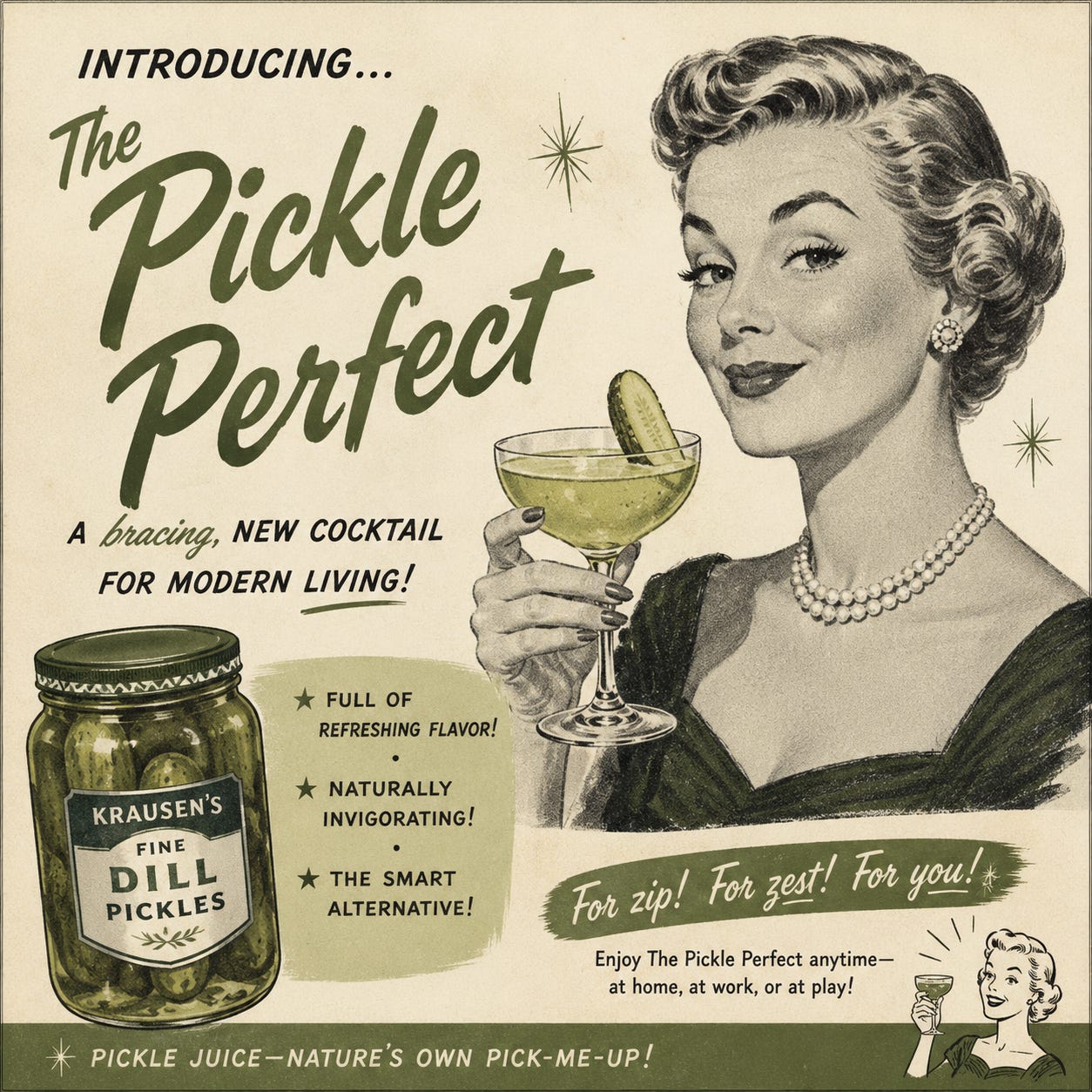
I briefly dated a woman who began each morning by downing a tumbler of apple cider vinegar. “Mmm!,” she would say, looking at me expectantly with raised eyebrows and encouraging me to join her.
I’m not saying that this is why it didn’t work out, but it didn’t work out. Vinegar, pickle juice and other acetic acid products catches me in the back of my throat, and causes an involuntary reflex as if I’m about to retch. Every so often I will order a cocktail made with a shrub to be adventurous, but with the result that anyone I’m drinking with grows alarmed. My trigeminal nerve fires (the same nerve that responds to carbonation) followed by a mild laryngospasm reflex in which my throat tightens against the acidity. I don’t remember my nightmares, but if I did I’m pretty sure one would involve standing immobilized in front of the Whole Foods kombucha case.
I don’t have a lot of company. The tangy, acidic flavor has been ascendant for several years — drinkers love lambic beer, kombucha, tepache, switchel, and such. The U.S. kombucha market is currently just over $1 billion, and is expected to triple by 2033.
These drinks are sometimes labeled as “functional drinks,” a relatively new category in which the function they serve is vague. This also includes drinks with CBD, vitamins, probiotics, adaptogens, and electrolytes. The FDA has wisely steered clear of defining functional drinks. Mostly, the category seems designed to make you feel better about paying a premium for something that holds the promise of improving your life, even if the promise remains elusive.
We probably all know someone who has that same sort of involuntary shudder when they sip a whiskey or rum — they lean forward, their eyes scrunch closed, their shoulder rise, and they shudder. This is owing to the same mechanism — the trigeminal nerve is triggered, the throat clenches, and every atom in the body says, “Do not swallow this!” (In extreme cases, even a sip of alcohol can trigger what’s called “alcoholic neuralgia,” which leads to sharp jaw pain that’s been compared to an electric shock.) I am fortunate to not be afflicted with this.
Do these similar physiological mechanisms help explain why vinegar-based and vinegar-adjacent drinks are rising in popularity? Maybe. Alcohol of course serves multiple purposes: It provides an excuse for socializing with friends. It gradually alters one’s mental state. And it kindles an internal hearth as it goes down, thanks to that trigeminal nerve response.
Vinegar drinks appear to duplicate that third response, and if you order with friends, it ticks the first box as well. What it doesn’t do is make you tipsy, change your outlook, make your feel immortal, or lower your inhibitions. (If the trend toward vinegar drinks continues, the prospects for karaoke bars appears dim.) And staying in control of one’s mental and physical state has evidently moved up the wish list for Gen Z.
And then there are the health considerations. Alcohol is a poison, and has well-documented adverse health impacts. Vinegar and pickle juice are touted for their health benefits. They help fight dehydration and benefits one’s gut health. Yay gut health!
One could also make the case that vinegar is just a more advanced form of alcohol. Alcohol is made when yeast attacks sugar. Acetic acid is made when bacteria attacks alcohol. And aren’t we all in favor of generating more advanced life forms?
Of course, pickling juice is brine, which is to say salt and water. All that salt may have an unfortunate impact on your blood pressure and strain your kidneys, which in turn may trigger gout flares.
But never mind that. Let’s get back to cocktails. The word “pickle” is evidently a cognate of the word “piquant,” by way of the Dutch word “pekel,” which is related to the Middle German word for “pierce.” And piquancy is chiefly what alcohol brings to a drink’s flavor. Makers of non-alcoholic spirits are on a relentless search to find ingredients that replicate the effect of the first warming sip of an alcoholic drink. As N/A producer Cut Above Spirits notes on its web page, “Alcohol’s ‘burn’ is a nerve reaction, not a flavor.”
They admit that it’s impossible to exactly replicate the sensation that alcohol conveys, but that’s okay. “The goal of a great zero-proof spirit isn’t to trick your body into reacting. It’s to give your senses something new, intentional, and enjoyable to explore.” Cut Above uses “chipotle pepper, guaiac wood, cubeba pepper, and even Sichuan pepper to create body, intrigue, and warmth” in its versions of whiskey, gin, mezcal and tequila.
Others embrace acetic acid, including Mother Root, a UK-based maker of nonalcoholic apertifs. “Our aperitifs are activated by apple cider vinegar – our version of liquid seasoning,” they write. All The Bitter, producers of a line of N/A bitters, is also uses apple cider vinegar to extract flavors from various herbs and spices.
But one needn’t rely on commercial producers to swap alcohol for acetic acid. Try making your own cocktails using pickle juice in lieu of your favorite gin or tequila. This pickle juice margarita sure looks like a traditional margarita. Others recommend an N/A bloody mary that subs pickle juice for vodka. And the creator of this pickle spritz reports that it’s “refreshing and crisp with a delightful tanginess too, just what you need on a hot and sunny evening!”
Maybe so. I’ll have to trust her on this. I’ll be sitting over in the corner with my laryngospasm reflex.
In the immortal words of Gene Ween, "In my mind, I'm fine / Accepting only fresh brine" (but actually no thanks, even if I'm currently staying away from alcohol and seeking n/a options)
An interesting post and while in theory what you have offered is interesting but i may have to pass. I guess at some age (78) alcohol in moderation works without any side effects. (LOL) I am hoping you have changed the life of, at least, one person with this post.