

What I Got Wrong About Corks (And You Probably Did Too)
I spent a few days in Portugal with Big Cork. Here’s what I learned


I spent last week in Portugal as a guest of the Portuguese cork association (APCOR) learning everything I needed to know about corks, and then a little bit more than I actually needed to know: where corks come from, how they’re made, where they go awry.
This was a wonderful trip not only because, well, Portugal, but because I have a huge hole in my soul that needs to be constantly filled with all manner of information about everyday objects. If you knew me when I was researching whiskey barrels a decade ago, I apologize for cornering you and talking endlessly about Bulgarian oak.
But let me tell you about corks! I’ll be organizing my thoughts and writing more coherent cork stories for print publications in the coming months, but I’ll start by highlighting some myths that were deflated during my field trip to the land of cork.
Myth: All corks are basically the same
The first night we went out to dinner and our host, Nisa Duarte, ordered a couple of bottles of wine. The waiter pulled out a cork and placed it on the table. Duarte grabbed it and inspected it carefully. It was a bit sheeny with paraffin. “I don’t like this one,” she said. “It’s not natural.” She performed similar examinations for many corks during the days we were together.
I am now a guy who also looks critically at corks. I learned all about natural corks, technical corks, microgranulated corks, colmated corks, and capsulated cork stoppers. Colmated corks were new to me — these are chemically treated to make them a pearly shade of white, and apparently are all shipped to the United States, the only country that wants them. And then there are champagne corks. Champagne corks are complex. I can’t get into it here. I’d need at least 4,000 words. (Note to editors: call me.)
Myth: Cork harvesting isn’t good for the environment
We visited a cork harvesting operation one morning on a low hilltop about an hour outside Lisbon. A half-dozen or so workers clambered around in the upper branches of beautifully gnarled trees with specialized axes in hand. (No one told me when I was eight years old that tree-climbing — with an axe! — was a career option, and I demand an apology.)

Cork is endlessly renewable — some of the trees we saw were more than 150 years old and still producing enough cork to keep all your cabernet from turning into vinegar. Government regulations require that trees rest at least nine years between harvests, so every decade or so a tree will have its bark stripped off in an operation that brought to mind the whale flensing scenes in Moby-Dick. The men in the trees expertly sloughed off huge slabs of bark in curved sheets, each about five or six feet long, which were gathered and collected on a trailer pulled behind a tractor.
After the harvest, the trees looked diminished and uncomfortable, like poodles after a visit to the groomer. Under the rough bark was a slightly damp, creamsicle-colored skin resembling a spongy membrane. Someone then came along with a bucket of white paint and a brush and painted a foot-high “6” on each freshly peeled tree, indicating that it was last harvested in 2026. The bark regenerates naturally, and around 2035 it will be ready for another flensing.

Apparently the bark expands outward, as the numbers aren’t covered over by new growth but remain visible for at least a decade. A harvester can damage a tree by cutting too deep, opening a door to infection. But they’re skilled and that rarely happens.
Screw tops are made of aluminum, which requires bauxite mines and massive energy inputs during manufacturing. Plastic corks require oil.
Do the environmental math. Advantage: cork.
Myth: Cork making is totally 18th Century and outdated
This may have once been the case, but no longer. While many cork forests (called montados) are on land owned by families for generations, after being cut the bark enters a modern industrial operation. I visited three cork manufacturers; by far the largest and most established in Portugal is Corticeira Amorim, which last year had revenues of about — checks notes — $1 billion. Only the best cork bark is used for natural bottle closures; the rest is ground and made into “technical corks” of compressed cork pieces. Ground cork also finds its way into cork flooring, cork insulation, and cork footwear components.
All the cork makers we visited had adopted high-tech methods for production over the past couple of decades, largely to offset the risk of TCA (more on that below). We saw a lot of lasers and robots involved in the manufacturing process. Various pricey machines analyze corks for flaws in a fraction of a second, deciding which are high quality, which are middling, and which should be rejected. Other robots slid sheets of cork into a circular saw to trim the edge before corks were punched out .
My favorite part was watching wine corks moving on lightning-fast conveyors out of the analyzers, upon which some would get blown off the assembly line by violent puffs of air and exiled into the dreaded Bin of Rejects. These will never know the warm embrace of a bottle of burgundy, but are destined to spend a cold eternity as the sole of a Birkenstock.
Myth: Corks are always to blame for musty-smelling wine or spirits
You’ve heard the phrase “corked” — describing a wine or spirit that smells off when opened? That’s thanks to TCA (2,4,6-trichloroanisole), a compound that can form when a fungus native to cork bark comes in contact with chlorine-containing elements. It produces an aroma often compared to damp cardboard or a wet dog, which makes it the whomp-whomp sad trombone equivalent of a smell.
The persistence of the term “corked” is unfortunate for the industry — corks get blamed all out of proportion to their faults. TCA contamination can also come from wooden barrels, pallets, or packaging that’s been compromised, although consumers will still complain that the product is “corked.” Rude!
Facing an industry-threatening challenge, cork makers started ramping up a couple of decades ago, and some producers now check every single cork for contamination. APCOR says the industry has invested about €700 million in equipment to ensure contaminated corks no longer get into the supply chain.
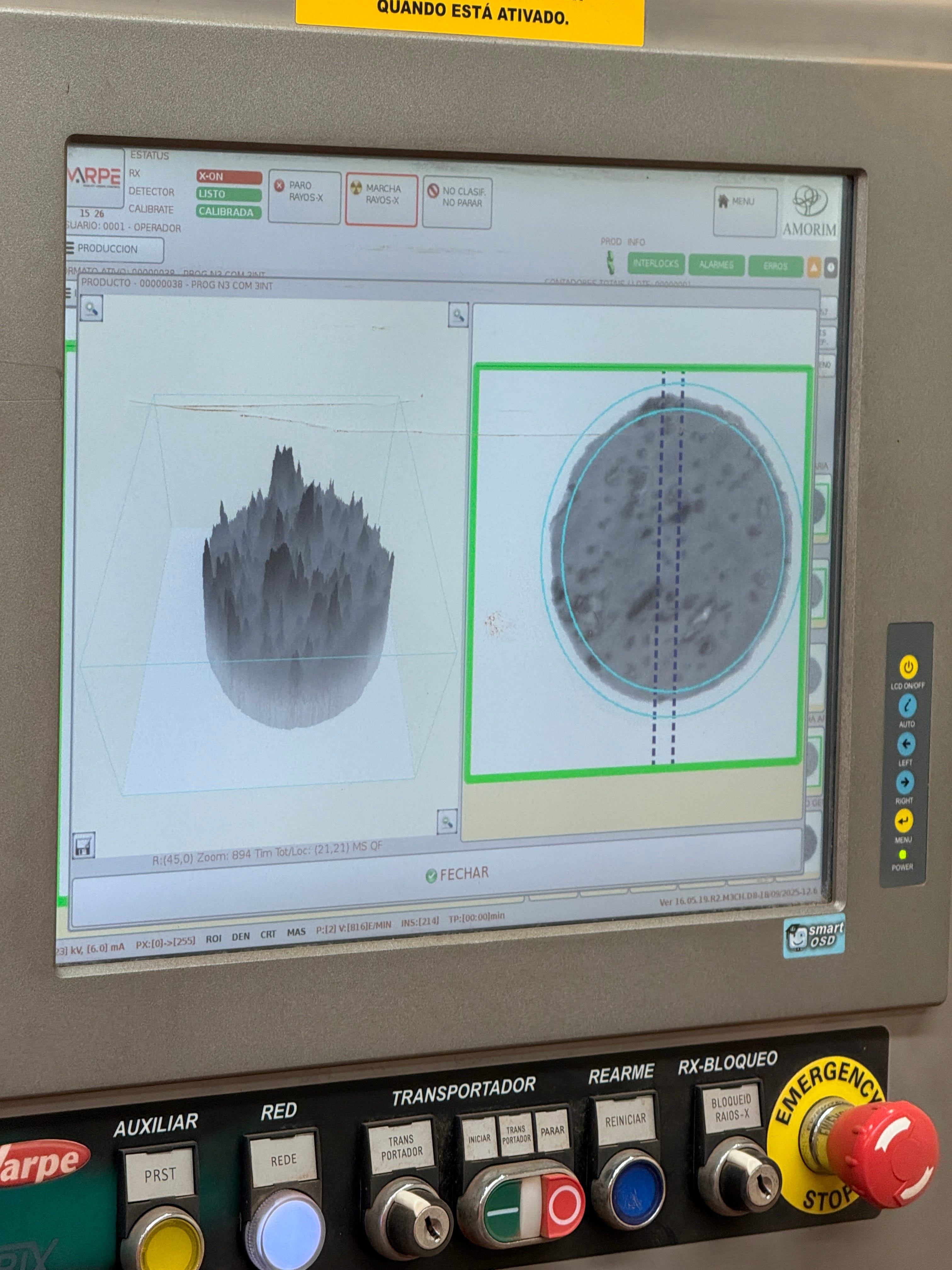
We saw two methods to detect TCA. Amorim has a battery of fancy gas chromatographs in which every cork is scanned and analyzed. Not long ago, this would have been cumbersome and prohibitively expensive — instead, a few samples from each batch would be analyzed — but the industry worked with mechanical engineers to allow every corks to be analyzed in seconds, then instantly rejecting those that fail.
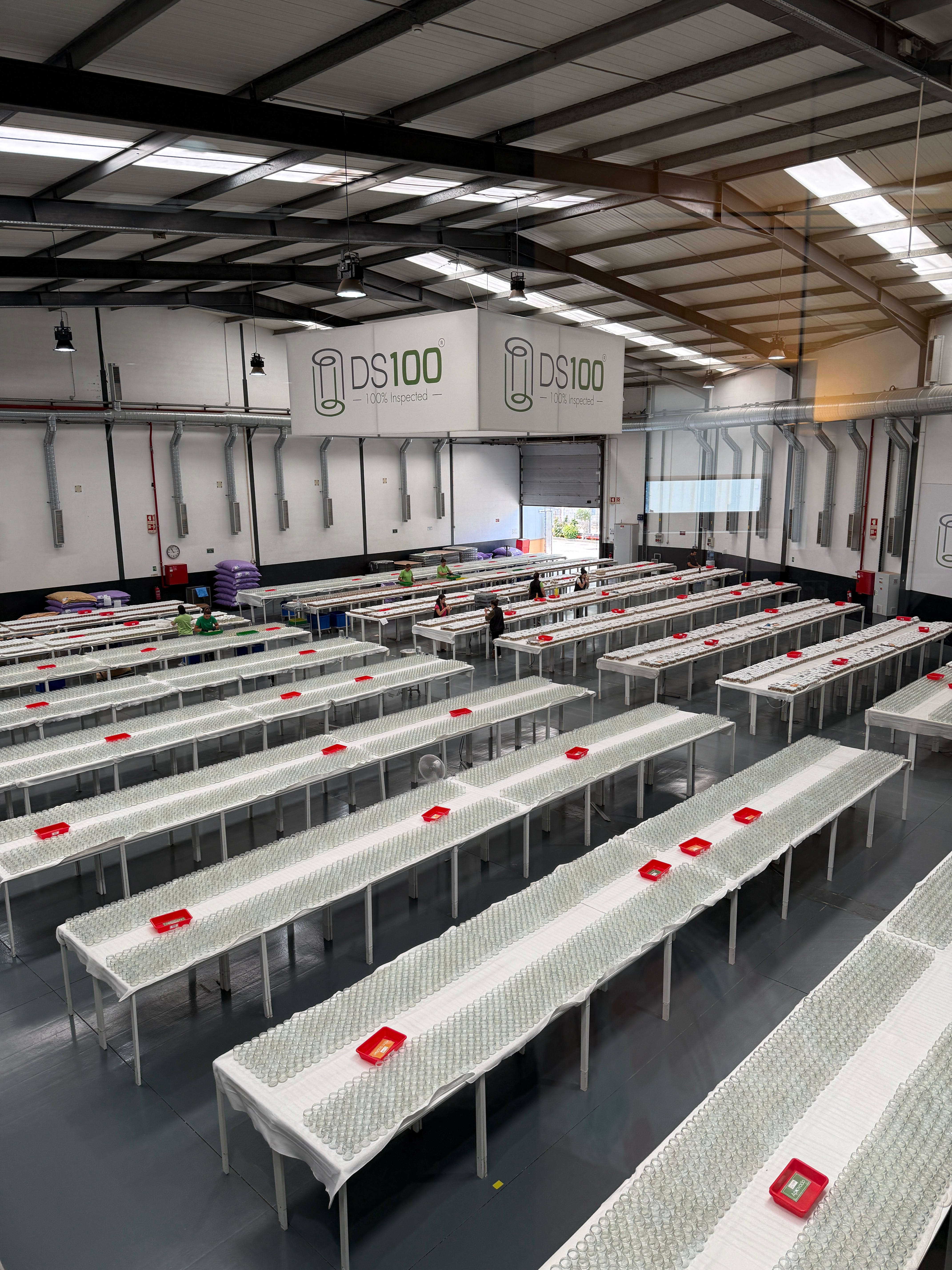
At Cork Supply, another major producer of corks for the beverage industry, we visited a hangar-sized room arrayed with dozens of tables on which sat hundreds of glass jars, each containing a few corks. A group of technicians worked through the jars; they were trained to sniff out unwelcome aromas with impressive speed, uncapping and snuffling one jar after another. Although not as high-tech as Amorim, the company noted that the human nose can simultaneously scout for flaws other than TCA, including aromas of mold, onion, and smoke.
Myth: Corks breathe
You often hear corks hailed as the perfect closure for wine. They’re semi-permeable, we’re told, preventing liquid from escaping but allowing oxygen to enter, thereby enhancing the aging process.
Cool story, bro. But not true.
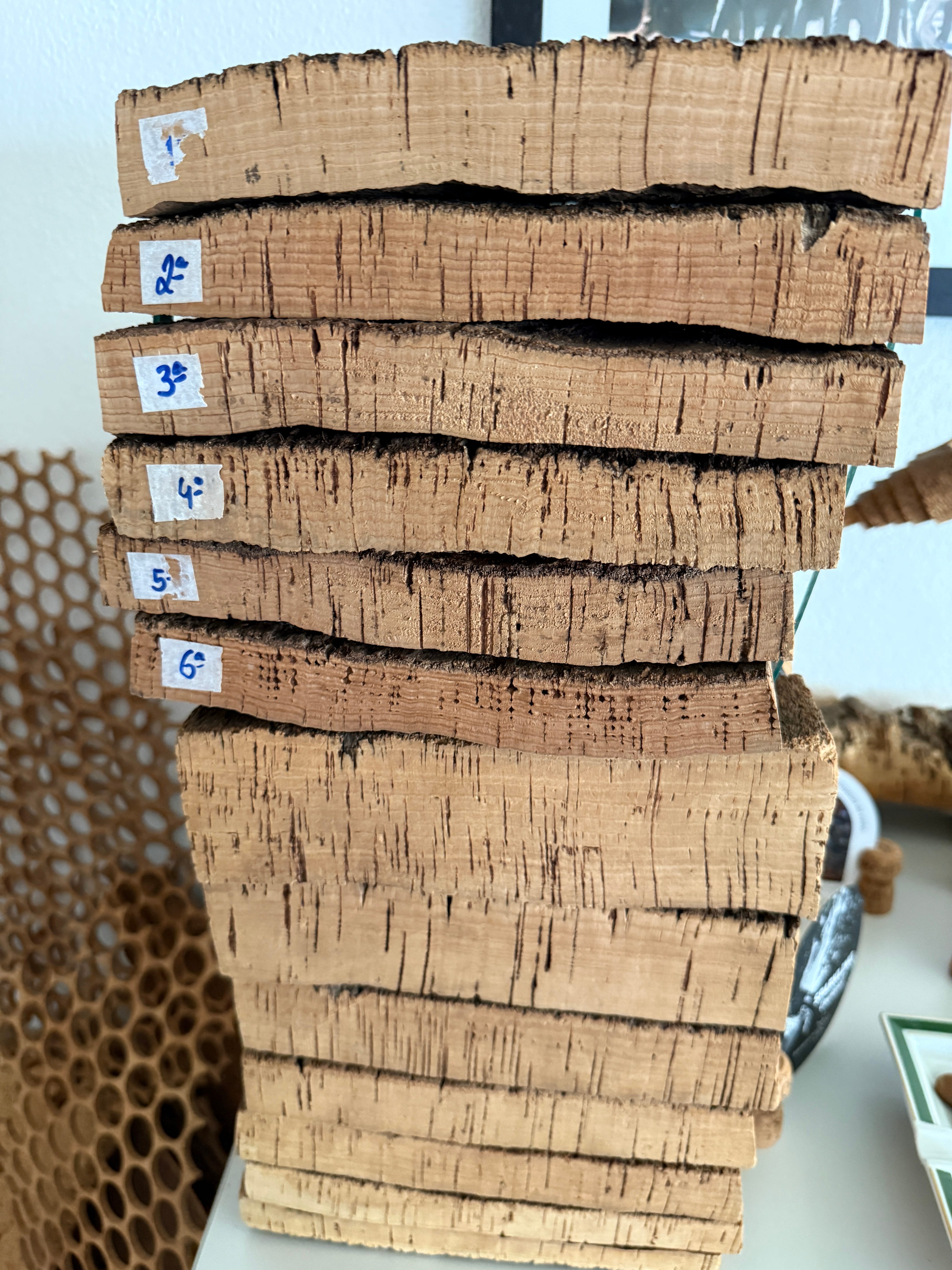
Corks are not in fact a membrane that permits oxygen from the outside world. They’re essentially impermeable. Technical corks (composites made of ground-up cork held together with a binder of some sort) are the most airtight. Natural corks are airtight for the first year, then may allow in minute measures of outside air through microscopic gaps between the cork and bottle neck. (Don’t get cork makers started about the imperfections inside wine bottle necks.) The least effective were synthetic corks, which allow outside air to enter as early as the first month of storage.
But natural corks do inject tiny amounts of oxygen into each bottle via other means. Cork bark has a loose cellular structure, which means it entraps oxygen within it as it grows. When corks are inserted into the bottle, they’re mechanically compressed to fit, which sets in motion a process in which some of that entrapped air is slowly squeezed into the wine itself. Good winemakers account for this when bottling. As we were told several times on our cork tour, a natural wine cork is less a membrane and more like scuba equipment — it brings its own oxygen supply and releases it slowly.
This field report only scratches the surface — we also visited someone who makes corks specifically for spirits, which differ from wine corks in that they’re designed to be repeatedly re-inserted into a bottle. He had much more to say, mostly about rounded corks versus corks with more subtle chamfers.
I won’t burden you with the details. I’ve had you backed into a corner long enough, and I can see the rising alarm in your eyes. Why do you keep looking over my shoulder in search of someone else to talk to? But, no, seriously, you should invite me to your next party. I will spend the evening pulling corks out of bottles and explaining to everyone why one cork is better than another. I promise it will be entertaining.
Back in the previous century, way up on a ridge in the Santa Cruz Mountains, a vintner told me that at a certain price point, with certain wines (table reds), and to save the good stuff for the great stuff, a screw top was just fine. "If you come across one of these bottles in your racks in 5 years, it means you lost it."
So, so good! And, you worked in flensing, a word I haven’t come across since my Judy Blume years. 🥂